ublo
bogdan's (micro)blog

bogdan » Stop Searching by Coincidence: The Case for Hybrid WordPress Search
05:10 pm on May 17, 2026 | read the article | tags: medium
I like WordPress. I’ve been using it long enough to know where it shines and where it very clearly doesn’t.
Search is one of those areas everyone quietly accepts as “good enough”, until the moment it actually matters. And when it does, you start noticing that WordPress search is not really search in the way users expect it to be. It’s closer to a polite filter. A LIKE query with a UI.
This article is the first in a series where I’ll document how I ended up building SearchPixel, a WordPress plugin backed by a separate search infrastructure that tries to move from string matching to meaning matching.
Before getting into embeddings, hybrid ranking, or architecture, I want to start with the uncomfortable part: why this problem exists at all.
Because if we don’t agree there’s a real problem here, everything else just looks like unnecessary complexity.
What WordPress search actually does
At its core, WordPress search is fairly simple. It takes the query string, splits it into words (loosely), generates an SQL query, then runs a set of LIKE '%term%' conditions over post title, content and excerpt to return whatever matches.
LIKE answers this question:
does this exact sequence of characters appear somewhere in this text?
Users, however, are usually asking something closer to:
which page on this site talks about the thing I’m thinking of?
Those two questions overlap sometimes. Often by accident.
Humans search by meaning. LIKE searches by coincidence.
Users rarely type what you wrote. They type half-remembered ideas, synonyms, typos, vague descriptions, problems, not solutions.
Say you have a post titled:
“How to speed up WordPress with caching and CDN”
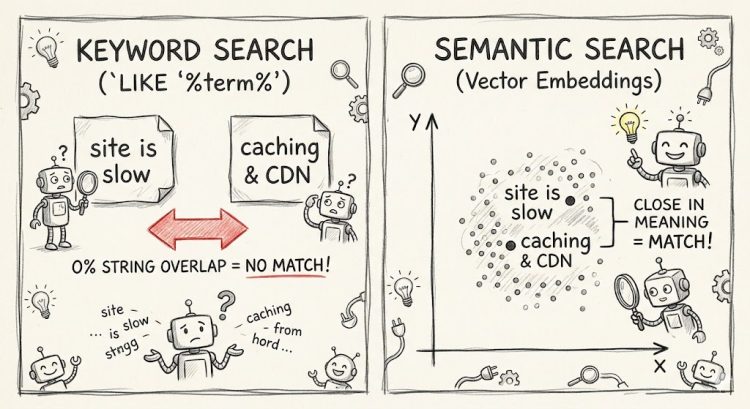
Users will search for something like: “site is slow”, “pages load slowly on mobile”, “optimize wordpress performance”, “cloudflare setup”, “cache plugin” or anything else vaguely related. Keyword search might do fine on “optimize wordpress performance”. It might get lucky with “cache plugin”. It will almost certainly miss “site is slow”. Not because the content isn’t relevant, but because relevance here is inferred from string overlap, not from meaning. And overlap is a fragile proxy.
Most improvements follow the same path. Start with better tokenization, weight titles higher, include tags and categories and do fuzzy matching from stemming and synonym lists. At some point, most people end up using an external search engine like Elasticsearch.
All of these help. A lot, actually. But they still rely on the same assumption:
relevance can be inferred from shared tokens
That assumption breaks in very predictable ways, mostly because human beings don’t coordinate their vocabulary with your content.
They will search for “cost” when your button says “price,” or “delivery” when your text says “shipping.” You can patch this by maintaining custom synonym dictionaries. It works, right up until it doesn’t, and you realize you’ve just built a brand-new maintenance problem.
Then, add human error to the mix. Combine fast typing with meme-generating mobile autocorrect, and your logs fill up with “aple,” “wordpres,” and “coudflare.” Keyword search doesn’t know what to do with a typo, so it just returns a blank page.
But the biggest breaking point is intent. If a user searches for “how to migrate” and your top article is titled “Moving between hosting providers”, a LIKE query treats them as entirely unrelated. They share no tokens.
By treating string overlap as a proxy for relevance, you aren’t actually matching intent—you’re just hoping for a linguistic coincidence. This will get worse really fast if you borrow idioms and expressions from other languages in your writing, turning “English” content into something only mostly English.
What hybrid search changes
To fix this, we have to change the underlying math of how search works. We start with semantic search to change the representation. Instead of comparing words, it compares embeddings: vector representations of text that (roughly) encode meaning. Queries and documents that talk about similar things end up closer together in this space. So “site is slow” can retrieve content about caching and CDNs, even if those exact words never appear. It’s not magic. It’s just a different coordinate system.
Keyword search asks: do these words overlap?
Semantic search asks: are these ideas related?
Both questions matter.
But semantic search has its own failure modes. It can be: too fuzzy, too tolerant and most of all surprisingly wrong in very confident ways. Exact matches still matter when you’re looking for error codes, version numbers, product names, quotes or any specific identifiers. Semantic search can rank “kind of related” above “exactly what I asked for”. Which is frustrating.
So this isn’t a “keyword vs semantic” story. It’s a both story. Hence the hybrid.
Why WordPress makes this harder than it sounds
There’s also an architectural reality check. WordPress is PHP, request–response, optimized for publishing and rendering pages. It’s not designed to run transformer models, compute embeddings, maintain vector indexes, perform semantic search, nor keep latency predictable under load. Sure, you can force it, but I wouldn’t recommend it.
The shape that makes sense, in practice, looks like this. You get a WordPress plugin for integration, UI, and content selection, paired with an external service for embeddings, indexing, and retrieval, with a clean API boundary between them.
That’s the direction SearchPixel took.
What SearchPixel is (today)
SearchPixel is a WordPress plugin plus a backend service that indexes selected WordPress content (you choose what goes in), then retrieves a capped number of top results to keep things fast by using a hybrid approach under the hood. All by trying to stay boring in production.
Right now it’s free while I iterate. If operating costs ever become significant, there will probably be a small cost attached because as far as I know, GPUs don’t run on enthusiasm alone.
What’s next
In the next article, I’ll move from “this is broken” to “this is how I designed around it”:
- architecture choices
- what runs where
- indexing trade-offs
- what I limited on purpose
- where latency actually comes from
For now, the short version is this:
WordPress search checks whether your content contains the words.
Semantic search checks whether your content contains the meaning.
Users usually come for meaning. So that’s where I started.
This is part one of an ongoing series building SearchPixel. If you want to catch the next post on architecture choices and indexing trade-offs, hit the Follow button so you don’t miss it.
find me:
in my mind:
- #artist 2
- #arts 4
- #away 3
- #bucharest 1
- #buggy 6
- #business 1
- #clothes 1
- #comics 1
- #contest 3
- #dragosvoicu 1
- #education 1
- #food 2
- #free-ideas 1
- #friends 14
- #hobby 23
- #howto 9
- #ideas 36
- #life lessons 4
- #me 59
- #medium 8
- #mobile fun 4
- #music 51
- #muvis 17
- #muviz 13
- #myth buxter 1
- #nice2know 15
- #night out 1
- #openmind 2
- #outside 3
- #poems 4
- #quotes 1
- #raspberry 4
- #remote 56
- #replied 51
- #sci-tech 7
- #sciencenews 1
- #sexaid 7
- #subway 39
- #th!nk 5
- #theater 1
- #zen! 4